

Next-Generation Waterless Cleansing Balms Market Trends 2036: Innovation Catalysts, Regulatory Impact & Revenue Forecast
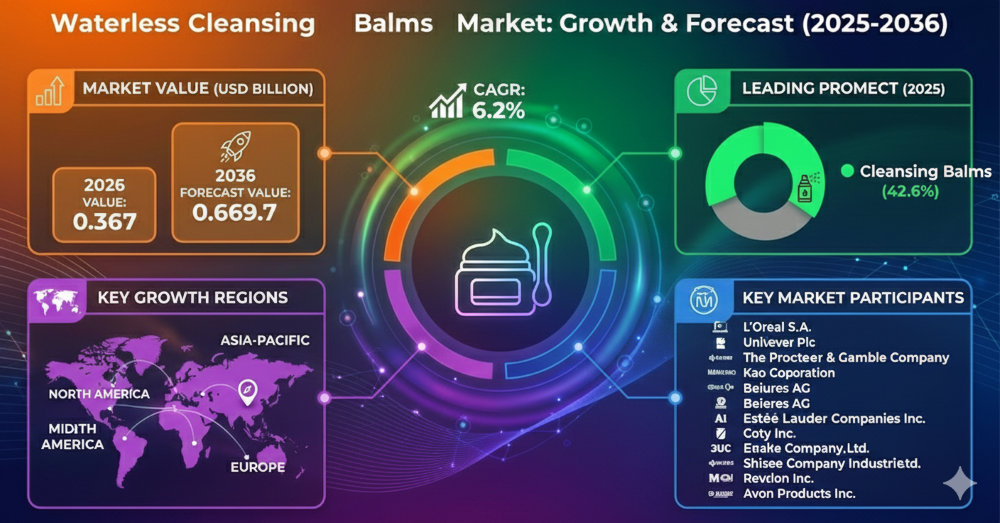
Waterless Cleansing Balms Market grows with demand for eco-friendly, travel-friendly skincare, minimal water use, and gentle yet effective cleansing formulas.
ROCKVILLE, MD, UNITED STATES, February 9, 2026 /EINPresswire.com/ -- The global waterless cleansing balms market is entering a pivotal "Multi-Functionality Phase," with its valuation projected to rise from USD 367.0 million in 2026 to USD 669.7 million by 2036. According to the latest industry data, the sector is set to expand at a compound annual growth rate (CAGR) of 6.2%, driven by a structural shift in the beauty industry toward resource conservation, ingredient potency, and travel-ready formats.As of February 2026, the transition from traditional water-based cleansers to anhydrous (water-free) formulations has evolved from a niche sustainability trend into a mainstream performance standard. This growth is propelled by the dual demand for "clean beauty" transparency and the rising global necessity for water-conscious manufacturing.
Request for Sample Report | Customize Report | Purchase Full Report - https://www.factmr.com/connectus/sample?flag=S&rep_id=14097
Market Dynamics: The Shift to High-Performance Solids
The surge in adoption is led by industry stalwarts and innovative indie brands alike, including L’Oréal S.A., Unilever, The Estée Lauder Companies, and Lush Cosmetics. These organizations are increasingly pivoting to waterless chemistry to eliminate the need for harsh synthetic preservatives and bulky, plastic-heavy packaging.
Key drivers for this decade-long expansion include:
Concentrated Efficacy: By removing water—which can make up to 70-90% of traditional cleansers—manufacturers are delivering 100% active formulations. This ensures that ingredients like botanical oils, antioxidants, and ceramides remain stable and potent without dilution.
Sustainability & ESG Mandates: With corporate water-reduction targets intensifying, brands are adopting "ambient temperature processing." This no-heat method preserves delicate actives and significantly reduces the carbon footprint of production.
Travel and "Skinimalism": Consumers are prioritizing leak-proof, TSA-compliant products that serve multiple roles. Modern balms now function as deep cleansers, makeup removers, and hydrating masks in a single, compact unit.
Segmentation and Regional Market Insights
The market is diversifying to address a broader range of dermatological needs and regional preferences. Natural and botanical formulations currently dominate the landscape, holding over 48% of the market share, as consumers seek plant-based alternatives to petroleum-derived ingredients.
Regional Growth Leaders
The geographic landscape reflects a high concentration of innovation in the East, with a steady adoption of "double cleansing" rituals in the West:
Asia-Pacific: Led by South Korea, Japan, and India, this region remains the fastest-growing market. India is seeing a surge in D2C (Direct-to-Consumer) brands catering to an eco-conscious youth population, while South Korea continues to lead in "balm-to-milk" technology.
North America: Representing the largest revenue share, the U.S. market is driven by the "Clean Beauty" movement and a high demand for luxury, clinical-grade anhydrous products.
Europe: Countries like France and the UK are at the forefront of sustainable packaging innovation, moving toward refillable and mono-material balm tins to comply with the EU's Packaging and Packaging Waste Regulation (PPWR).
The Evolution of Cleansing Technology
In 2026, the industry has moved beyond the "greasy" textures associated with early balm iterations. Next-generation formulations now feature micro-emulsion technology, allowing oil-based balms to rinse away instantly with water without leaving a residue.
Furthermore, the rise of gender-neutral branding has expanded the target audience. The men's grooming segment is adopting cleansing balms as an effective solution for deep-pore cleansing and post-shave skin barrier repair, moving away from traditional alkaline soaps that strip the skin.
About the Industry Outlook
The waterless cleansing balms market represents a strategic intersection of environmental responsibility and superior skincare science. As retailers reconfigure shelf space to favor concentrated, low-waste formats, this segment is positioned to remain a high-growth pillar within the broader USD 22 billion global waterless cosmetics industry.
To View Related Report:
Pallet Market https://www.factmr.com/report/pallet-market
Leather Luggage and Goods Market https://www.factmr.com/report/leather-luggage-and-goods-market
Eyewear Market https://www.factmr.com/report/eyewear-market
Pharmaceutical Glass Packaging Market https://www.factmr.com/report/pharmaceutical-glass-packaging-market
About Fact.MR
Fact.MR is a global market research and consulting firm, trusted by Fortune 500 companies and emerging businesses for reliable insights and strategic intelligence. With a presence across the U.S., UK, India, and Dubai, we deliver data-driven research and tailored consulting solutions across 30+ industries and 1,000+ markets. Backed by deep expertise and advanced analytics, Fact.MR helps organizations uncover opportunities, reduce risks, and make informed decisions for sustainable growth.
S. N. Jha
Fact.MR
+ +1 628-251-1583
sales@factmr.com
Legal Disclaimer:
EIN Presswire provides this news content "as is" without warranty of any kind. We do not accept any responsibility or liability for the accuracy, content, images, videos, licenses, completeness, legality, or reliability of the information contained in this article. If you have any complaints or copyright issues related to this article, kindly contact the author above.
